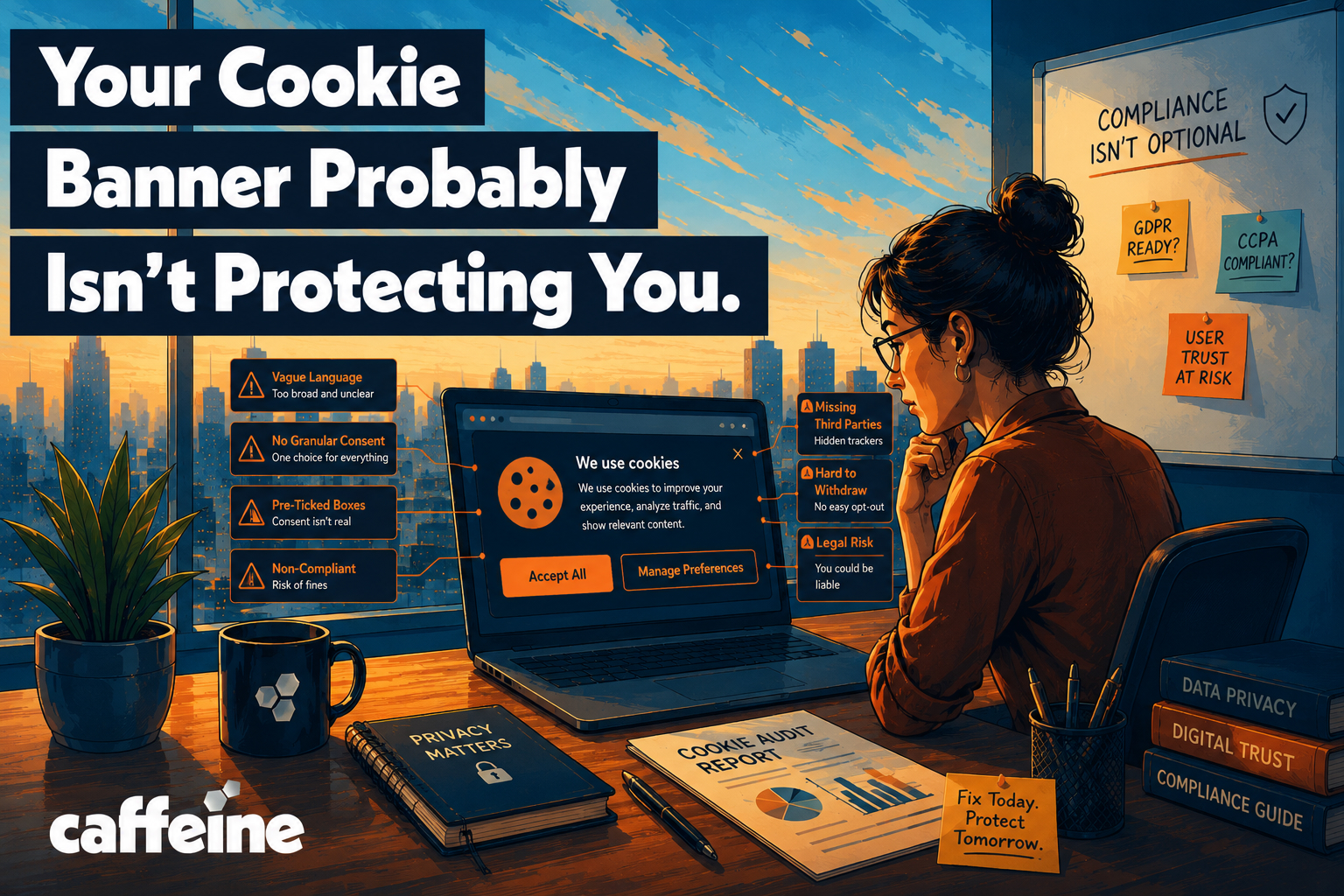
Clients keep asking us the same thing: does my cookie banner protect me from these website tracking lawsuits?
For most sites, no. The banner is decoration. And the threat behind the question is real and growing fast — reportedly 800+ CIPA claims filed in 2025, with 2026 projected to see tens of thousands of claims filed. This is now a national operating cost, not a California quirk.
This is the short, do-this-now version.
Why this is a real risk, not a scare story
CIPA — the California Invasion of Privacy Act — is a 1967 wiretapping law. Serial litigants, usually attorneys themselves (like this guy) argue that ordinary website tracking (analytics, pixels, chat widgets, session replay) is the modern equivalent of tapping a phone line. The economics are what make it dangerous:
| Lever | Why it bites |
|---|---|
| $5,000 per violation | Statutory. No proof of harm needed. |
| Per-visitor math | Every California visitor argued as a separate violation. |
| Cheap to file, costly to defend | Demands priced just below your cost to win — so even weak claims get settled. |
| AI automation | Firms now scan thousands of sites and auto-generate demand letters at near-zero cost. |
You don’t need to lose in court to lose money. Most companies write the settlement check because fighting costs more. That’s the trap, and it’s already catching people across hospitality, retail, and transportation/travel.
The one thing that’s changed: it’s about timing now the Sidelines
Without trying to get too technical, in 2025 the question was “do you have a banner?” That’s dead. Now it’s: did your tracking fire before the user consented?
A banner that pops up while Google Analytics (which pretty much any reader of this article will use) and the Meta Pixel have already loaded, saying “Do you accept cookies?” is not protection — it’s evidence you knew you should have asked.
The banner is not the thing. The blocking is the thing.
Where your exposure actually lives
| Risk | Tools | Notes |
|---|---|---|
| Highest | Session replay, AI chat (Hotjar, FullStory, recording live chat) | AI chat is worse if the vendor trains on conversations — that breaks the standard legal defense. |
| Medium | Pixels & tags (Meta Pixel, GA via GTM) | Volume-driven. The bulk of filings. |
| Sneaky | Your search bar & forms | If keystrokes ship to Google/HubSpot/Meta as users type, you fit the exact target profile in current demand letters. Most owners have no idea theirs does this. |
Test your own site in 5 minutes (do this first)
This is the same check plaintiff firms automated. Run it before they do.
- Open your site in an incognito window.
- Before clicking the banner, open dev tools (F12 → Application → Cookies).
- See _ga, _fbp, or other tracking cookies already there? Your CMP isn’t blocking — it’s notice-only.
- Now type in your search bar and watch the Network tab. If your terms get shipped to a third party as you type, that’s the exact thing the lawsuits target.
Finding the problem is easy. Fixing it is usually straightforward.
The fix: a 6-step action plan
- Inventory every third-party script — pixels, analytics, chat, session replay, SDKs. Know what loads and exactly when.
- Test firing order in incognito with dev tools. Anything tracking before consent is yours to fix.
- Make California and the EU opt-in so nothing non-essential fires until “yes.” Geo-target (CookieYes, Cookiebot, OneTrust) so you keep full analytics on US traffic everywhere else. For most US businesses with some California traffic, this hybrid is the sweet spot.
- Mask or suppress keystroke transmission in your search bar and forms.
- Audit any AI chatbot’s data terms. If they train on conversations, get consent before the chat opens and name the vendor in your privacy policy. (Note: a “you’re chatting with AI” disclosure does not satisfy CIPA consent — two different obligations.)
- Keep consent records, make the banner accessible (ADA requires it — keyboard reachable, visible focus, real contrast; don’t trust a “WCAG compliant” badge, test it), and re-check quarterly. Tools change, laws change, the banner that worked in spring breaks by fall.
Pick the right banner
| Option | Verdict |
|---|---|
| Notice only (“we use cookies” + OK) | Fails everything. Zero CIPA protection. |
| Basic opt-out (“Do Not Sell” link, cookies still load) | Satisfies CCPA, but no CIPA protection — tracking starts before consent. |
| Geo-targeted (opt-in for CA + EU, opt-out elsewhere) | The practical winner. Real consent where you need it, full analytics everywhere else. |
| Full GDPR-style opt-in everywhere | Strongest. Kills CIPA exposure, but costs you analytics on all traffic. |
Bottom line
Don’t treat this as a compliance tax — treat it as hygiene. Gating your tracking protects you legally and forces you to finally know what’s running on your own site, which almost nobody does. Get it right once and it’s one less thing to worry about.
If you want us to audit what your site is really doing — before someone with dev tools and an AI script does it for you — reach out. That’s exactly the work we do.
DISCLAIMER BECAUSE CLAUDE TOLD US TO: This post is for informational purposes only and does not constitute legal advice. Privacy laws vary by jurisdiction and evolve over time. Consult a qualified attorney or privacy professional to ensure your practices meet applicable legal requirements. Caffeine disclaims any liability for actions taken based on this content.