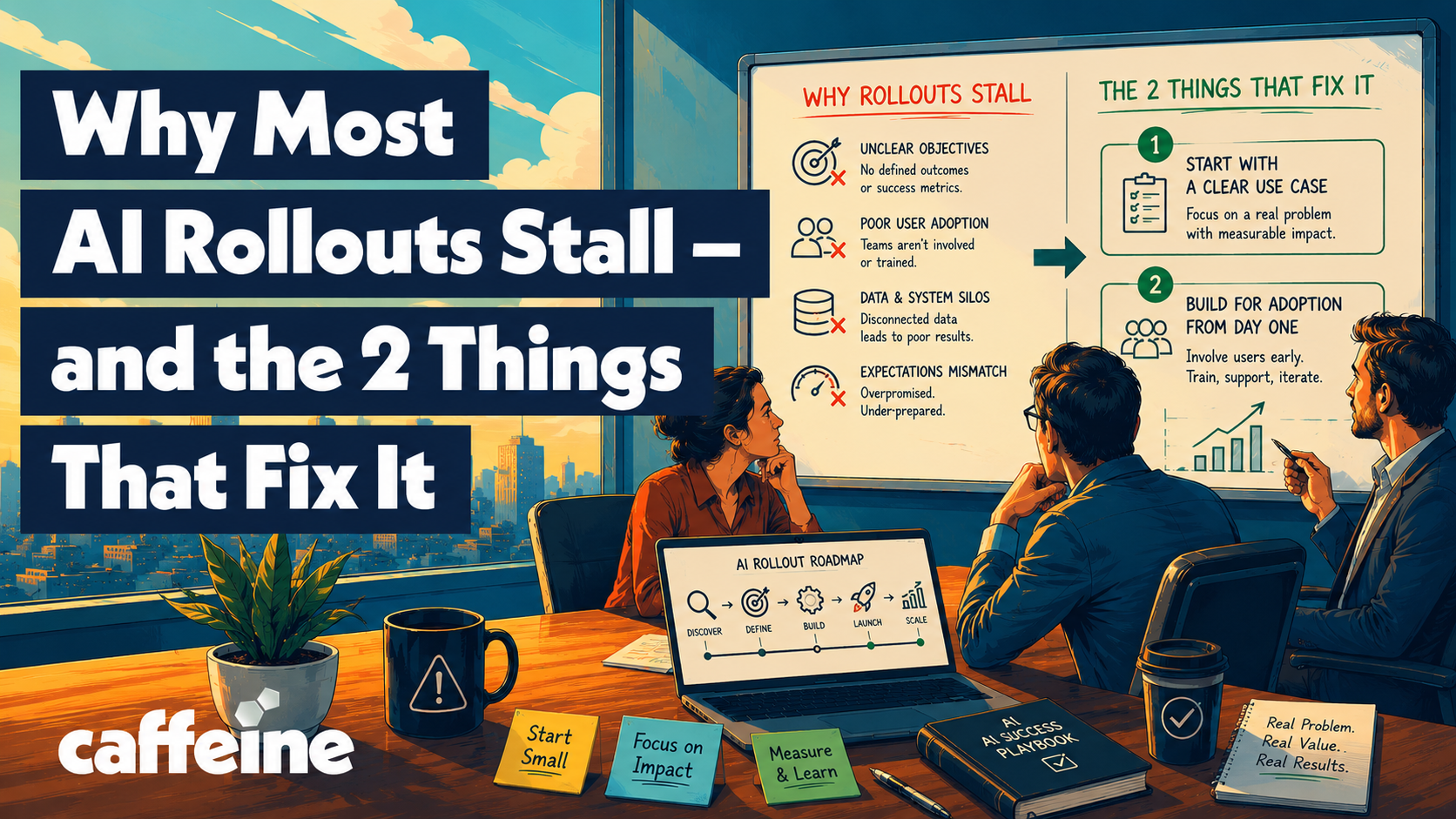
Companies are spending serious money on AI right now. McKinsey’s 2024 State of AI report found that 65% of organizations are regularly using generative AI — nearly double the rate from just a year prior. And yet, a Rand Corporation study found that 80% of AI projects either fail outright or never make it to production. That’s not an AI problem. That’s an organizational readiness problem.
We’ve been watching this play out with clients across industries, and the pattern is remarkably consistent. The companies that are actually extracting value from AI investments have two things in common that have nothing to do with which model they chose or which vendor they signed with.
The Two Unglamorous Prerequisites
Here’s what separates the companies seeing real ROI from the ones sitting on shelfware:
- Well-documented workflows — written processes that define who does what, when, with which tools, at every key step.
- Clean, accessible, current data — information that AI can actually consume, query, and act on without human babysitting at every turn.
That’s it. Not proprietary infrastructure. Not a dedicated AI team of 20. Not a seven-figure technology investment. Documented processes and decent data.
Neither is glamorous. Both are fixable. But the path to fixing them is harder than most executives expect — and for different reasons.
Why Process Documentation Is the Harder Problem
Data has a known remediation path. It’s painful, it takes time, and it requires resources — but organizations have been cleaning and migrating data for decades. There’s a playbook. (And increasingly, AI itself can accelerate the cleanup, which we’ll get to.)
Workflow documentation is a different beast. It asks something most organizations aren’t culturally built to do: think structurally about how work actually gets done.
Not how the org chart says it gets done. Not how the employee handbook describes it. How it actually gets done — the tribal knowledge, the workarounds, the “we always check with Sarah before sending that” moments that exist entirely in people’s heads.
When we work with companies on AI readiness, this is consistently where progress slows. Not because people are resistant to documentation — most aren’t, in principle. But because the act of writing a workflow forces a conversation that organizations often avoid: Do we actually have a consistent process here? Or do five different people do this five different ways?
The answer, more often than not, is the latter. And that’s not a criticism. It’s a natural byproduct of growth. But it means that before AI can do anything useful, humans have to do the work of standardizing how they operate.
A language model can draft a customer follow-up email in seconds. But it needs to know: Who is the customer? What’s the context for the follow-up? What tone does your brand use? What CRM fields should be updated afterward? What’s the approval chain? If those answers live in someone’s head and nowhere else, AI has nothing to work with.
What “Good” Process Documentation Actually Looks Like
This isn’t about writing a policy manual nobody reads. Effective process documentation for AI integration has three characteristics:
- Task-level specificity. Not “handle customer inquiries” but “receive inquiry via [channel], log in [CRM] within 2 hours, categorize by [type], assign to [role], respond using [template or guidelines], follow up in [X days] if no response.” AI needs steps, not summaries.
- Tool mapping. Every step should identify which system is involved — CRM, email platform, project management tool, data source. This is what allows AI to be connected to the actual workflow rather than floating alongside it.
- Decision logic. Where a human makes a judgment call, document the criteria. “Escalate to manager if [condition].” AI can replicate decision logic. It cannot replicate undocumented intuition.
Companies that have this in place can hand a workflow to an AI implementation team and have a working prototype in weeks. Companies that don’t are still mapping their processes three months in.
The Data Problem (and Why AI Can Help)
Clean data is the other prerequisite — and the good news is that “clean” doesn’t mean “perfect.” It means:
- Accessible. Data your AI tools can actually reach. Siloed systems, disconnected databases, and spreadsheets living on someone’s desktop are non-starters.
- Consistent. Fields that mean the same thing across records. If “revenue” is calculated three different ways in three different reports, the AI will produce three different answers.
- Current. Stale data produces stale outputs. If the AI is working from a customer database that hasn’t been updated in 18 months, the outputs reflect that.
Here’s where a pragmatic AI strategy pays off: several of the early, lower-risk AI use cases — deduplication, field standardization, gap identification, categorization — are exactly the tasks AI handles well. You don’t have to get the data perfect before you start. You can use AI to help get it there, while running initial implementations on your cleanest data sets.
The mistake companies make is treating data readiness as a prerequisite that must be fully resolved before AI work can begin. It’s better thought of as a parallel workstream. Start with what you have, use AI to accelerate cleanup, and expand scope as data quality improves.
What This Means for Your AI Roadmap
If your organization is evaluating AI adoption or trying to figure out why a recent implementation underdelivered, start here — not with the technology stack.
Audit two things before your next meeting with a vendor or internal champion:
- Pick three core business workflows. Can you write them down, step by step, with tools and decision points identified? If not, that’s your first AI project — and it has nothing to do with AI.
- Pull a sample of data from your primary system of record. Is it complete? Consistent? Would you be comfortable having it drive automated decisions? If the answer makes you nervous, that’s the work.
The companies winning with AI right now didn’t start with the most sophisticated models or the biggest budgets. They started with the operational discipline to know how their business runs. The AI just made that discipline more valuable.